Employee engagement platform: redesigning the hybrid workplace experience


- Hybrid work is now an established model: corporate offices must offer a clear reason to commute, combining purposeful collaboration, suitable spaces and reliable technology.
- Employee experience goes beyond office amenities: engagement depends on an inclusive, frictionless journey supported by useful services, community and everyday workplace tools.
- An employee engagement platform helps organizations adapt: centralizing hybrid-work coordination, space booking, services, communication and workplace data improves both employee experience and space utilization.
In 2026, agile and human-centered management remains a top priority for human resources. In a context where hybrid work is now an established operating model, HR departments at corporate HQ must continue adapting their approach to attract, retain and engage talent:
- creating inclusive collaborative ecosystems,
- designing flexible spaces for a premium experience,
- optimizing daily space utilization through smart services and reliable data,
- adapting to evolving employee expectations.
An employee engagement platform can support this strategy by giving employees one place to access workplace information, coordinate office days, book resources, join community initiatives and use the services available to them.
Improving employee well-being is a true competitive differentiator for companies. Such a strategy promotes team engagement while also enhancing customer satisfaction, as customers increasingly seek to support responsible businesses.

What is an employee engagement platform?
An employee engagement platform is a digital solution that helps organizations inform, connect and involve their employees. It centralizes features such as internal communications, events, workplace services, feedback, hybrid-work coordination and resource booking, creating a more connected and engaging employee experience across office and remote locations.
When “Employee” means “Ambassador”
Choosing agile, human-centered management means acknowledging an obvious truth, amplified today by social media: a brand’s first ambassadors are its employees. The authenticity of employee testimonials shared through platforms like LinkedIn, Glassdoor or Blind directly influences employer brand image.
This principle aligns with the Service-Profit Chain, the framework popularized by Harvard Business Review, which shows that employee satisfaction and engagement drive service quality, which in turn drives customer loyalty and profitability. In short, companies get the customer experience they are willing to give their own people.
In a highly connected world, a company can increase its visibility by engaging its employees. Professional social networks, employee reviews and user-generated content are effective tools for companies to harness the power of content creation by their employees. By applying the logic of the Service-Profit Chain, a company supports the sustainability of its performance through:
- Reducing turnover rates and the associated recruitment and onboarding costs,
- Attracting talent across generations and profiles,
- Building authentic and lasting engagement among employees and customers.
An employee engagement platform does not create advocacy on its own. However, it can give employees easier access to useful information, events, services and opportunities to participate in workplace life, helping the organization turn its engagement strategy into a consistent daily experience.
Hybrid work: creating value to motivate employees to return to the office
Strengthening employee engagement in physical spaces, such as corporate offices, requires a social and structural approach adapted to mature hybrid work. In 2026, the market is not returning to the old five-day office model: organizations are formalizing office-attendance expectations while preserving flexibility. CBRE’s 2026 workplace benchmark reports that 89% of surveyed organizations have a formal hybrid program, while average office utilization has risen to 53%, with much higher peaks on popular attendance days.
Companies must therefore create useful experiences that justify the commute: modular collaborative spaces, reliable hybrid-meeting technology, focus areas, practical services and opportunities to exchange ideas on both professional and informal topics.
This transformation requires human resources and workplace teams to rethink the office value proposition, integrating accessibility and inclusion, as well as environmental concerns and the needs of different roles.
Thus, improving quality of life at work can motivate employees to use the workplace more purposefully.
Developing the employee experience within corporate offices therefore involves offering added value that remote work cannot provide. Today, this means prioritizing a functional, inclusive and connected workplace rather than relying on amenities alone:
- Well-being and productivity services: meditation spaces, gyms and group fitness classes, concierge services, dining areas with healthy and local products, quiet zones and concentration areas, etc.
- Technology and equipment that remove friction: reliable video-conferencing rooms, ergonomic and connected furniture, interactive floor maps, room-booking displays and universal charging stations.
- Community experiences: regular internal events, inter-team co-working spaces, mentoring and networking programs, community impact and volunteering programs, etc.
What results can companies expect? Employees join and remain with the company with greater motivation, engagement and loyalty, a mindset that can also positively affect customers.

The employee engagement platform: a central hub for the workplace experience
Developing a new strategy for employee well-being at corporate HQ cannot be done without considering the tools made available for this purpose. Applications for space management, workplace services, human resources and other aspects of company life are highly valued by organizations seeking to optimize time, space and employee well-being.
In a hybrid workplace, the role of an employee engagement platform extends well beyond internal communication. It connects community features with attendance coordination, resource booking, workplace services and practical on-site information, so that each office day can be planned with a clear purpose.
This connected approach remains a major trend because it centralizes services, community, bookings and workplace data. Its role is not simply to aggregate tools: it must make hybrid office days easier to plan and help workplace teams adapt spaces and services to actual demand.
.avif)
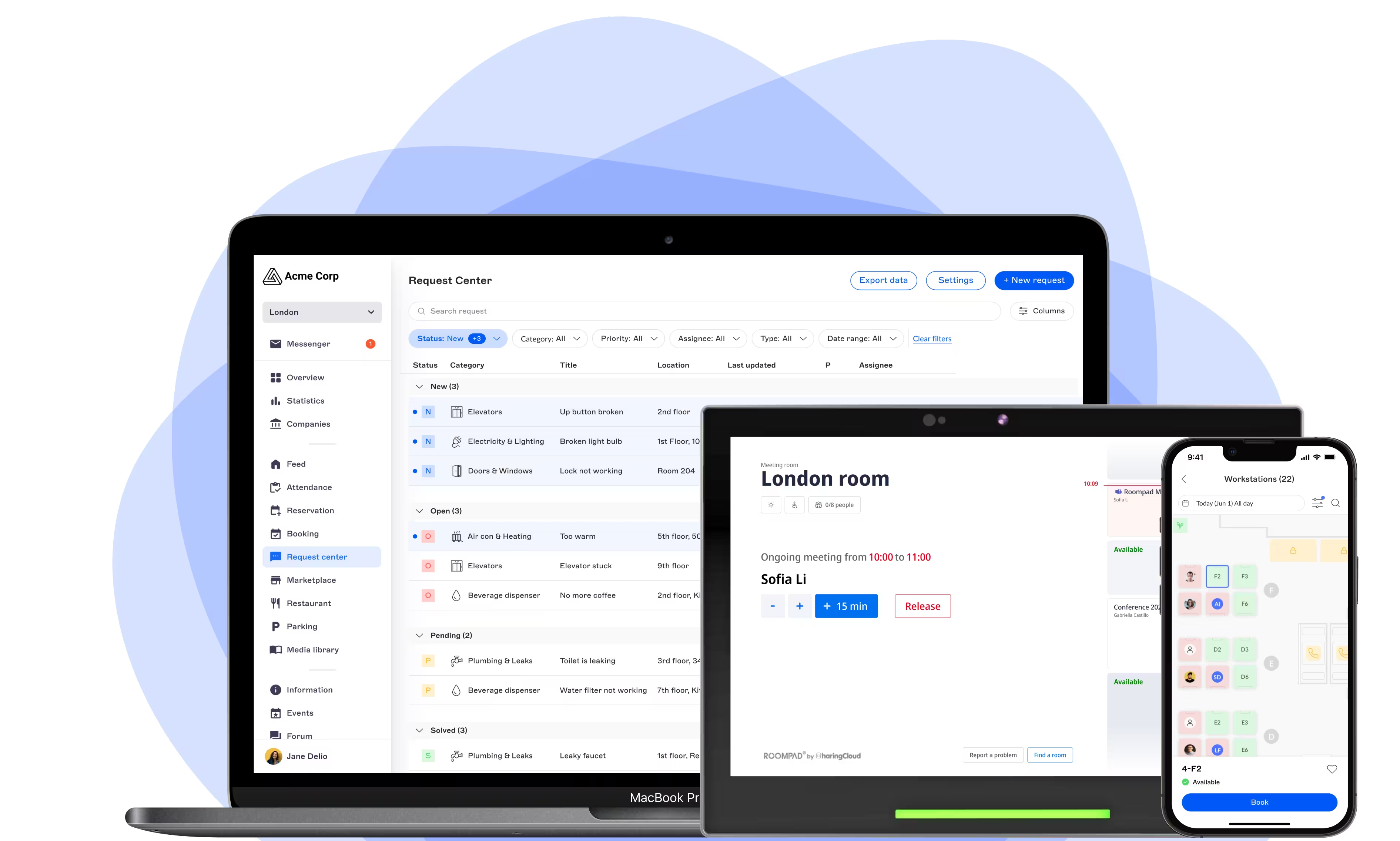
An all-in-one employee engagement platform like Witco helps improve employee well-being and facilities management through a range of high-performing native services, complemented by integrations adapted to each client’s needs. Beyond a customizable and scalable solution, the features offered to companies and their employees enable:
- smooth organization of hybrid work (attendance declarations, visibility into colleagues’ plans, desk and parking reservations and configurable hybrid policies),
- intelligent space management (real-time availability, interactive floor maps, occupancy sensors, RoomPad displays, check-in and no-show management, and space-usage analytics),
- centralization of services (concierge, catering, transportation and well-being),
- community building (news feed, events, useful contacts and targeted information),
- improved visitor hospitality (pre-registration, access instructions, Wi-Fi connection, host notifications and self check-in),
- integration with everyday tools such as Microsoft 365 (including Outlook, Teams and Places) and Google Workspace.
In today’s competitive business environment, employee experience remains a key driver of customer satisfaction. This underscores the importance of prioritizing employee well-being within corporate offices.
Organizations that thrive will be those that know how to combine active listening, innovation, workplace data and a human-centered approach, while offering employees a fulfilling and frictionless experience. An employee engagement platform can help bring these dimensions together and turn engagement objectives into a practical workplace experience.
Frequently asked questions about employee engagement platforms
How does an employee engagement platform support hybrid work?
Can an employee engagement platform encourage employees to return to the office?
What features should an employee engagement platform include?
How does Witco support employee engagement?